 |
| This Micro-observatory image is of Jupiter and it's moons. All I did to process the image was reduce the noise so that you can distinguish the moons better. My recent images of galaxies have been distorted by cloud cover so they are not worthy to post, sadly. |
Thursday, May 22, 2014
Micro-observatory Image 4.10

APOD 4.8
 |
| This beautiful, barred spiral galaxy is known as M61 or NGC 4303. It's bright spiral arms, immense dust lanes, and short central bar remind us of our own galaxy, the Milky Way. It is located about 55 million light-years away, nearby the Virgo Super Cluster of Galaxies. When it was first discovered by Barnabus Oriani in 1779, it was mistaken for a comet. I selected this image as today's APOD because we are nearing the end of the school year so our astronomy final exam is coming up and one of the topics on the exam is going to be galaxies. |
Friday, May 16, 2014
APOD 4.7
This is another different APOD post. The above link will take you to the APOD website where you can get a live view of Earth from the International Space Station (ISS). The cameras that are supplying the incredible view were recently installed and are part of a project where they will be assessing the effects of high energy radiation, which cameras work best, and which camera angles are the most popular.. In total, there are four cameras each pointing in a different direction. With the ISS completing an orbit every 90 minutes, you can see the alternating light and dark side of the Earth every 45 minutes. Although this live feed will be terminated eventually, there may be more projects like this for everyone to take part in.
APOD 4.6
 |
| This APOD is an image of NGC 3628 (the Hamburger Galaxy) in the constellation Leo. This galaxy is about 100,000 light years across and has a faint tail that extends from the left part of the galaxy. The tail itself is 300,000 light years in length, extending off of the above image. The tail's presence may be due to gravity and tidal forces from it's neighbors M65 and M66. These three galaxies are known as the Leo Triplet. I chose this APOD because we have recently started doing citizen science and have been classifying galaxies on the site. |
Thursday, May 15, 2014
APOD 4.5
 |
| This APOD is a total lunar eclipse sequence of multiple different images layered over each other. The very scenic view is from Waterton Lakes National Park in Alberta, Canada on the 15th of April. Each of the images of the Moon are separated by 10 minutes of movement. You can clearly see when the Moon is completely in the shadow of the Earth by how red the lunar surface appears. Also in the image, you can see the progression of Mars (above the Moon) and Spica (below the Moon). |
Wednesday, May 14, 2014
Margaret Geller Biography
Margaret Joan Geller is an American astrophysicist born December 8, 1947 in Ithaca, New York. She was encouraged by her mother, Sarah Levine Geller, to study science and mathematics. Geller did not receive any specialized education until she was in college. In 1970, Geller received a Bachelor of Arts degree in Physics at the University of California, Berkeley. The second university she would attend would be Princeton, where she would spend four years until she received her Ph.D. in Physics. After graduating she moved to Cambridge, England to study at the Institute of Astronomy. In 1980, she moved back to the United States of America to become an assistant professor of Astronomy at Harvard University. It was at this time where she and John P. Huchra, a coworker, began carrying out a red-shift survey for the Center for Astrophysics (CfA). The survey's purpose was to map all galaxies above a certain brightness at a maximum distance of 650 million light years in a particular part of the sky. According to the Big Bang Theory the sky should be homogeneous and uniform in the distribution of galaxies, but that is not what Geller observed. She first observed this in the constellation Bootes in 1981. There was a 100 million light year gap between galaxies in the area. After being an assistant professor for two years, she joined the Smithsonian Astrophysical Observatory as a permanent scientific staff. In 1988, she became the head professor for Astronomy at Harvard University. Up until the 1990s, she continued her survey of galaxies with Huchra. Their first published observations of a 135 degree slice of the sky showed a thin layer of galaxies that appeared to line the walls of a "bubble-like" empty space. They would later call this the "Great Wall." This wall of galaxies is five times denser than the average density of galaxies spread out across the sky. What blew the minds of Geller and Huchra was the fact that the wall was only 15 million light years thick compared to it's 500 million light years in length. Even though they discovered this phenomena, they were not able to explain it. One theory is that areas in space before the Big Bang were "clumpy," so when the the Big Bang occurred they were distributed unevenly. Another theory is that unusually high amounts of dark matter hold the galaxies in place. Even though they continue to survey the sky, they still do not know how to explain this phenomena.
In 1990, she won the MacArthur Foundation Fellowship and the Newcomb-Cleveland Prize of the American Academy of Arts and Sciences; two of her most important awards. Her most recent and notable award is the 2014 Karl Schwarzchild Medal of the German Astronomical Society. To this day she continues to study galaxies and their evolution and she has taken up an interest in X-ray astronomy.
In 1990, she won the MacArthur Foundation Fellowship and the Newcomb-Cleveland Prize of the American Academy of Arts and Sciences; two of her most important awards. Her most recent and notable award is the 2014 Karl Schwarzchild Medal of the German Astronomical Society. To this day she continues to study galaxies and their evolution and she has taken up an interest in X-ray astronomy.
Tuesday, May 13, 2014
Micro-observatory Image 4.9
 |
| This processed Micro-observatory image is of the Eagle Nebula (Messier 16) located in the constellation Serpens. At the center of the nebula is a young, open cluster of stars. Around the stars are clouds of dust from which the stars are "born" from. In the image you can sort of see the dust clouds and their pillar-like shape. When processing, I did not reduce the noise of any of the RGB pictures so it is minimally adjusted. This attempt at processing an image of the Eagle Nebula was much more successful than my last attempt. The images I received last time were distorted by clouds so they were blurry. |
Monday, May 12, 2014
Micro-observatory Image 4.8
 |
| This Micro-Observatory image is of the Crab Nebula (Messier 1). You are not able to see the distinctive filaments of the object, but you can make-out it's prolate spheroid shape. The Crab Nebula eminates more blues and greens in the visible spectra, so those are the colors that dominate the image. All I did in terms of processing it are automatically adjusting all three parts of the image via log and reducing the noise of them. In the lower right corner of the image you can still see some noise so there may have been a cloud there at the time the pictures were taken. |
Friday, May 9, 2014
Micro-observatory Image 4.7
 |
| This Micro-Observatory image is of the sun. All I did to is was sharpen it so you can see a clearer outline of the sunspots on the photosphere. |
Thursday, May 1, 2014
APOD 4.4
 | |
|
APOD 4.3
 |
| This APOD was taken on April 3rd when Mars was near opposition. This means when Mars was opposite the Sun in the sky. At this time it appears to be very bright and is at the best time to be viewed by telescopes from Earth. On the Martian planet you can see the north polar ice cap and the clouds of water vapor forming around it's towering mountains and volcanoes. For a picture of Mars at opposition, but seen from the naked eye, look at the post "APOD 4.2." |
Wednesday, April 30, 2014
Micro-observatory Image 4.6
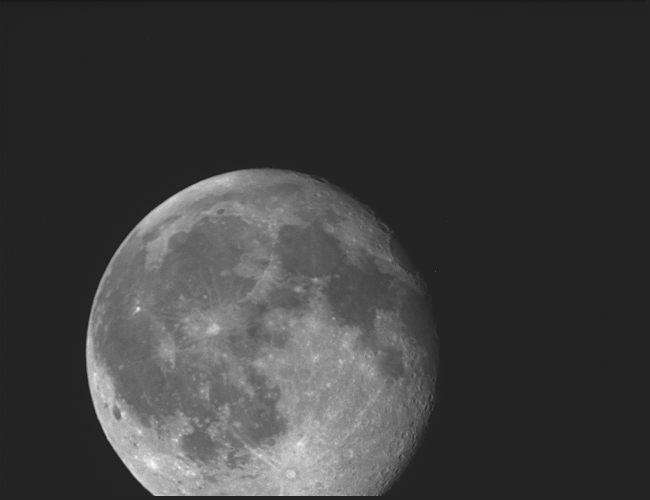 |
| As you can tell, this is the Moon. The picture was taken by the Micro-observatory telescopes on the 17th of April during its waning gibbous phase. The only thing I did to it was sharpen it so you can see more definition of the lunar surface. |
Micro-observatory Image 4.5
 |
| This processed image is of Messier 8 (the Lagoon Nebula). I was able to get very clear red, green, and blue images so a stacked them to produce this single picture. A good amount of shifting had to be done as you can see at the bottom of the image where the green is. I did not reduce the noise or sharpen it so it is minimally processed. This emission nebula can be found in the constellation Sagittarius and is one of only two star-forming nebulae visible to the naked eye. The other is Messier 42 (the Orion Nebula). |
Micro-observatory Image 4.4
 |
| This is a processed image of Messier 13 (the Hercules Cluster). On the Observing With NASA site, you could not request a color image so there was not much to be done with it. What I did do however is reduce the noise, sharpen it, and change the color way to "fire." You can find this object in the constellation Hercules. It composed of nearly 200 galaxies and is about 500 million light-years from the Earth. |
Monday, April 28, 2014
Citizen Science #2
Today on zooniverse.com, I studied lunar surface images from the Lunar Reconnaissance Orbiter. In the activity, you are to mark out craters, mounds, and other objects. Usually in one image there are hundreds of things to mark out so it is very tedious. Also, this is one of the more simple activities on the site so I did not find it too intriguing.
Friday, April 25, 2014
Citizen Science #1
I spent today's Astronomy period searching star forming regions of the Milky Way Galaxy for active star formation on zooniverse.org. I was really interested in this activity so it is the only one I did. What you did in the activity was mark out empty "bubbles" in nebulae to show where star formation is occurring. You also marked out EGOs, star clusters, galaxies, and other objects. Next time, I will try one of the other activities that are on the site.
Thursday, April 24, 2014
Micro-observatory Image 4.3
 |
| This is a Micro-observatory processed image of Messier 20 (the Trifid Nebula). I requested images of the nebula in red, green, and blue color wavelengths. I changed the color table of each of the pictures to their appropriate color and shifted them so they stacked properly. Even though I reduced the noise of the images before I altered them, there is still some significant noise left. The noise explains the speckled look of the darker parts of the image. |
Wednesday, April 16, 2014
Micro-observatory Image 4.2
 |
| This is a picture of the Milky Way. You can clearly see the milky band of the galaxy span across the sky in this picture. All I did was adjust the image and sharpen it. There was not too much to be done because I was not able get pictures in color. |
Tuesday, April 8, 2014
APOD 4.2
 |
| This is a photograph of two of the brightest objects in the sky at the time. Mars, with its rusty red hue, and Spica, with its vibrant blue hue. Mars appears so bright because it is nearly at its closest to earth for 2014. It will not appear as bright until 2016. I selected this APOD because last night I viewed and made some observations of this. If you are wanting to view this as well, follow the arc of the "big dipper" to Arcturus and then speed on to Spica. It should be in the southeast. |
Subscribe to:
Posts (Atom)